


RIJAG President Takeo Harada Participates in the United Nations Global Dialogue on AI Governance
Advancing Global Policy Dialogue on International Order and “AI-Enabled Governance” in the Age of Artificial Intelligence
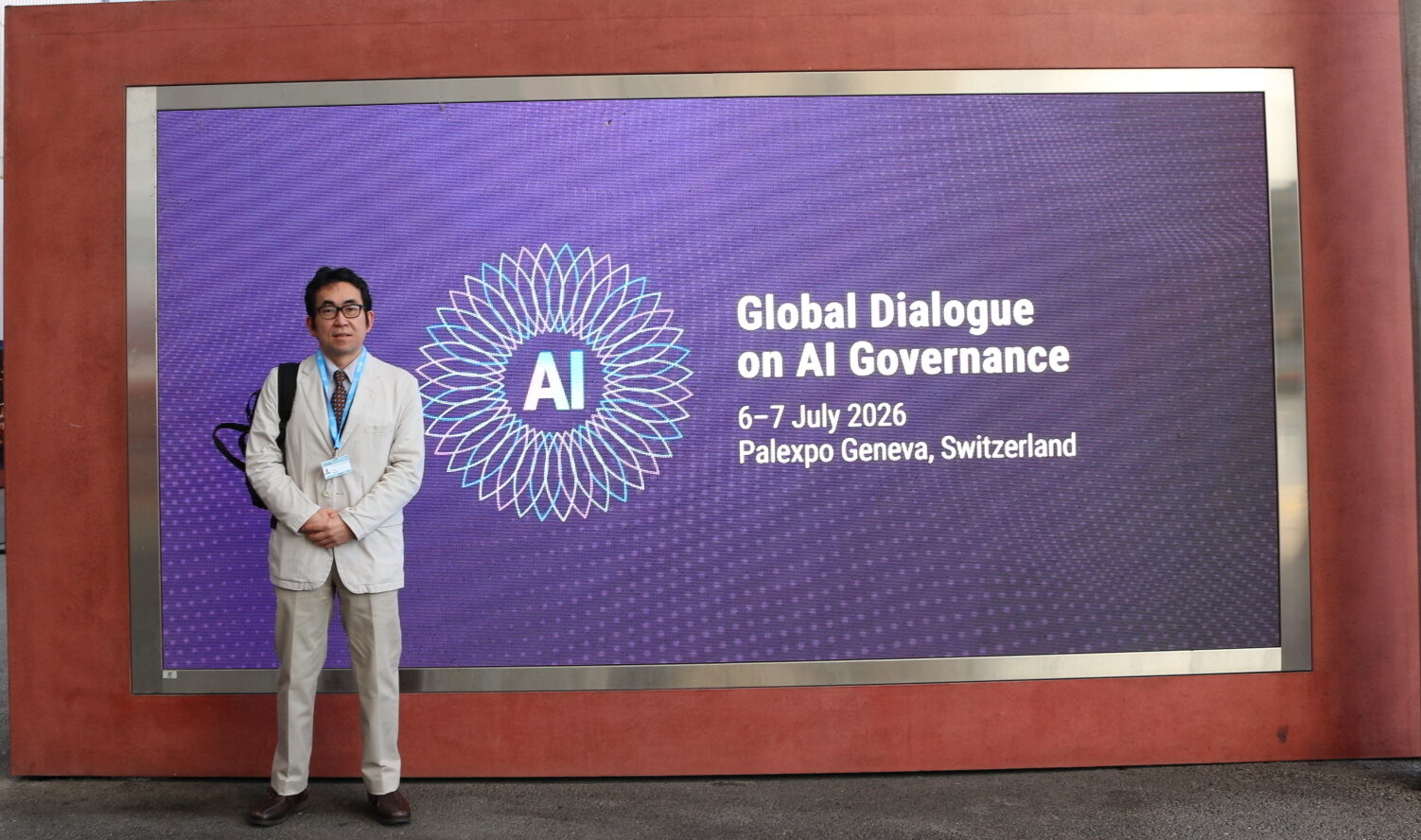
On 6 and 7 July 2026, Takeo Harada, President and Representative Director of the Research Institute for Japan’s Globalization (RIJAG), participated in the United Nations Global Dialogue on Artificial Intelligence Governance, held at the Palexpo International Exhibition and Convention Centre in Geneva, Switzerland.
The Global Dialogue was established within the United Nations pursuant to General Assembly resolution 79/325 as the first comprehensive international platform dedicated to artificial intelligence governance.
It was created to bring together Governments and a broad range of relevant stakeholders—including international organizations, the private sector, civil society, universities, research institutions, and the technical community—to advance international cooperation, exchange good practices and lessons learned, and facilitate open, transparent, and inclusive deliberation on the governance of artificial intelligence.
The Dialogue was established against the broader institutional backdrop of the Global Digital Compact, adopted at the United Nations Summit of the Future in 2024. Its purpose is to contribute to the development of international frameworks through which the benefits of artificial intelligence may be shared across the international community, rather than remaining concentrated within a limited number of technologically advanced States or institutions.
Participants included the Secretary-General of the United Nations, the President of the United Nations General Assembly, Heads of State and Government, ministers, and senior representatives of international organizations, including the International Telecommunication Union (ITU), the United Nations Educational, Scientific and Cultural Organization (UNESCO), and the United Nations Office for Digital and Emerging Technologies (ODET), as well as representatives of the private sector, academia, civil society, and the technical community.
Throughout the two-day Dialogue, participants considered scientific developments relating to artificial intelligence and its social, economic, ethical, cultural, linguistic, and technical implications. Deliberations were structured around four principal thematic clusters:
- AI opportunities and their social, economic, ethical, cultural, linguistic, and technical implications;
- bridging AI divides through capacity-building, access, and digital foundations;
- safe, secure, and trustworthy AI, including interoperability and compatibility among governance approaches; and
- respect for human rights, transparency, accountability, and meaningful human oversight.
The programme further included high-level governmental plenary sessions, multistakeholder exchanges involving Governments, industry, academia, and civil society, presentations of practical AI governance initiatives and approaches, and a wide range of side events.
Taken together, these discussions addressed not only the regulation and responsible deployment of artificial intelligence, but also the broader question of how international order, institutions, and governance itself may need to evolve in the age of AI.
President Harada participated in the Dialogue as part of RIJAG’s continuing engagement with the United Nations system.
RIJAG holds Special Consultative Status with the United Nations Economic and Social Council (ECOSOC) and has continued to contribute to international policy discussions concerning artificial intelligence, governance reform, sustainable development, and the future architecture of international cooperation.
RIJAG and its affiliated organization, the Institute for International Strategy and Information Analysis, Inc. (IISIA), are currently advancing research and practical implementation centred on the concept of:
“AI-enabled governance.”
This approach does not regard artificial intelligence merely as an object of regulation or risk management.
Rather, it examines how AI may be used to redesign and strengthen governance capacity itself in response to demographic transformation, shortages of skilled human resources, institutional fatigue, regional disparities, and geopolitical change.
It seeks to explore how policymaking, policy implementation, public administration, intergenerational knowledge transfer, local decision-making, and international cooperation may be reconfigured through AI-assisted and data-driven approaches.
President Harada has previously brought this perspective before the international community.
In April 2026, he submitted a video question concerning AI-enabled governance to the United Nations General Assembly hearing with candidates for the position of Secretary-General, speaking from the standpoint of civil society.
In May 2026, he also participated as a stakeholder speaker in the Third Informal Stakeholder Consultation on the Global Dialogue on Artificial Intelligence Governance, where he presented the concept of AI-enabled governance within the broader international policy discussion.
His participation in the Geneva Dialogue therefore constituted a further development of this continuing engagement and an important opportunity to connect policy concepts and intellectual contributions originating in Japan with the emerging institutional architecture of global AI governance.
In addition, the Kusunoki Project, a social contribution and capacity-building initiative jointly advanced by RIJAG and IISIA, has been featured on the United Nations Global Dialogue on AI Governance’s AI Dialogue Partnerships Hub as a practical model addressing Japan’s shortage of digitally skilled human resources through AI education, capacity-building, and intergenerational learning.
The Kusunoki Project provides hands-on workshops in Tokyo, Osaka, and Hiroshima, with a focus on Python programming, Retrieval-Augmented Generation (RAG), Large Language Models (LLMs), and AI-assisted development.
Its participants include university and graduate student interns, working professionals, business leaders, members of the IISIA community, and their families and children.
By bringing together participants across generations and professional backgrounds, the Project seeks to cultivate practical capabilities for the AI era while creating a sustainable model for knowledge transfer and collaborative learning.
This initiative is closely aligned with one of the central themes of the Geneva Dialogue:
“Bridging AI Divides: Capacity-Building, Access and Digital Foundations.”
Under the vision of realizing Pax Japonica, RIJAG and IISIA will continue to advance research, practical implementation, and international dialogue across the fields of artificial intelligence, geopolitics, public policy, human capital development, and international institutional design.
RIJAG will also continue to communicate knowledge, policy perspectives, and practical models originating in Japan to the international community, contributing to the formation of a peaceful, inclusive, and sustainable international order in the age of artificial intelligence.
Research Institute for Japan’s Globalization (RIJAG)